Enterprise RAG development services for trusted knowledge.
Turn approved documents, databases, and knowledge repositories into answers your teams can verify.
BlueMouse.ai designs and builds retrieval-augmented generation systems for organisations whose documents carry consequences: law firms, finance teams, engineering groups, and regulated operations across the UK. We build the ingestion, retrieval, citation, evaluation, and deployment layers needed to move from a chatbot experiment to a dependable knowledge service, and we measure it before anyone relies on it.
Citedevery answer links to its passage and version
Permissionaware: source access carried into retrieval
Measuredretrieval and answers tested separately
What is included
What our RAG development services include.
A RAG system is several systems working together. We scope each layer explicitly, so you know what is being built, what it will be tested against, and what you will own when it is done.
RAG readiness assessment
Map your repositories, their owners, permissions, and update cycles, and collect the questions people actually ask. Decide whether RAG, OCR, conventional search, or a combination is the right starting point, and write the acceptance criteria before any code.
Knowledge source integration
Connect SharePoint, Google Drive, document management systems, databases, ticketing tools, and internal APIs through authenticated connectors that respect each source's own permissions and refresh on a schedule you set.
Document processing and chunking
Parse native and scanned files, run OCR where needed, and segment content along its real structure: sections, clauses, tables, and headings. Every chunk carries metadata such as version, date, owner, and jurisdiction so retrieval can filter on it.
Hybrid retrieval and ranking
Combine keyword search for identifiers and exact terms with semantic search for meaning, fuse the two with reciprocal rank fusion, filter by metadata and permissions, and rerank the shortlist with a cross-encoder where precision at the top matters.
Answers are assembled only from retrieved passages. Each cites the document, page, and version it used, and the system declines when the sources do not support a confident response instead of filling the gap.
Permission-aware security
Identity, source-level access, tenant separation, retention, and audit logging are designed into the index and the query path. A user can only receive evidence from content they are allowed to open.
A reviewed test set of real questions and expected sources, with automated measurement of retrieval recall, citation precision, answer faithfulness, refusal behaviour, latency, and cost. It runs before launch and again whenever sources or models change.
Deployment and managed optimisation
Private cloud, on-premise GPU, commercial API, or hybrid deployment, with monitoring, feedback capture, and a review cadence that keeps retrieval quality up as the knowledge base grows.
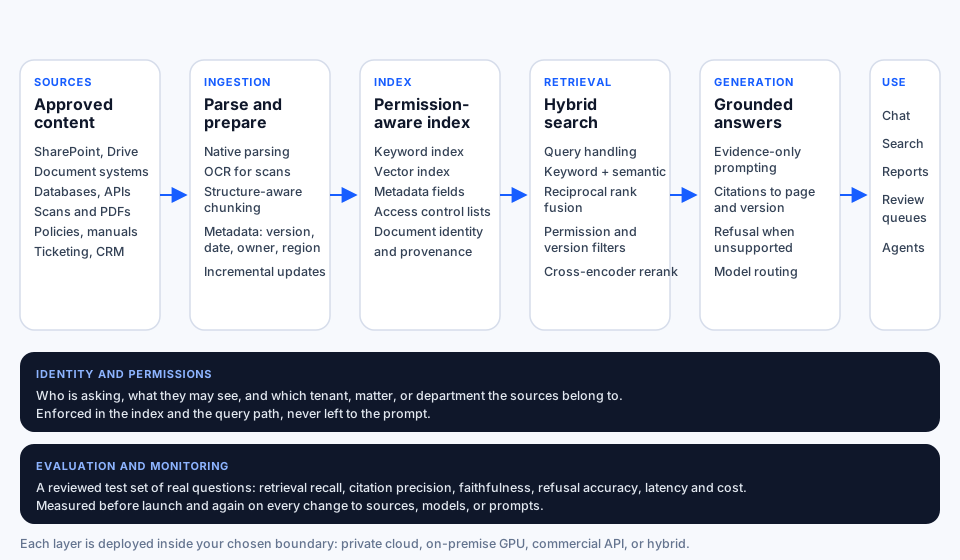
Every engagement is built on the same reference architecture, adapted to your sources, security boundary, and deployment model. The diagram shows the six layers and the two concerns that cut across all of them.
The reference architecture. Identity is enforced in the index and the query path, never left to the prompt, and evaluation runs on every change.
Technology choices
Selected for your boundary, not our habit
We are not tied to a single stack. Vector search may run on pgvector, Qdrant, OpenSearch, or Azure AI Search; keyword retrieval on OpenSearch or Elasticsearch; embeddings and language models from commercial APIs or open-weight models such as Llama and Mistral served on private GPUs. The choice follows your data boundary, latency, and cost constraints, and we document the reasoning so it can be revisited.
What you own
Everything, in your environment
Source code, prompts, evaluation sets, infrastructure definitions, and documentation are delivered into your repositories and environments. There is no proprietary runtime you depend on us for. The evaluation harness we use during the build stays with your team, so you can measure the effect of every later change yourself.
Retrieval design
The design decisions that decide whether RAG works.
Most RAG failures are retrieval failures that look like generation failures: a fluent answer built on the wrong passage. These are the decisions we make deliberately, with your documents in front of us, rather than by default.
Decision
How we decide
Chunking strategy
Structure-aware: sections, clauses, table rows, and headings, with the heading path stored as metadata. Fixed-size windows only as a fallback for genuinely unstructured text.
Dense, keyword, or hybrid
Hybrid by default when queries include identifiers, codes, names, or clause numbers. Dense-only retrieval is tested against the evaluation set, never assumed.
Fusion and reranking
Reciprocal rank fusion merges the two ranked lists without score calibration. A cross-encoder reranker is applied to the fused shortlist when precision at the top matters more than latency.
Metadata filters
Version, date, jurisdiction, product, department, and permission filters are applied before ranking, so the right document family is searched, not just the right words.
Query handling
Query rewriting, acronym expansion, and multi-query retrieval where user phrasing diverges from source language. Each technique is adopted only if it improves the test set.
Grounding rules
Answers are restricted to retrieved passages, with explicit refusal when evidence is insufficient, and citation formats that a reviewer can check in seconds.
Model selection
The smallest model that passes the evaluation set at the required quality, with larger models reserved for the hardest query classes. Cost per query is tracked from the first pilot run.
Freshness
Incremental re-indexing on source change, stale-content flags, and a documented update policy per repository, so yesterday's policy does not answer today's question.
Delivery process
From a defined knowledge problem to a tested production service.
Six steps, each ending in something you can read, test, or approve. You can stop after any of them with the work so far in hand.
01
Introductory call
Understand the users, the questions they ask, the sources that should answer them, and the security and deployment constraints. You leave knowing whether RAG is the right tool.
02
Source and document review
Inspect repositories, formats, permissions, and content quality. Collect representative questions and start the reviewed evaluation set that the whole project will be measured against.
03
Written scope
A short proposal naming the document set, the required outputs, the evaluation approach, the deployment boundary, and the acceptance criteria the pilot must meet.
04
Pilot build
Ingestion, hybrid retrieval, citations, and a working interface on your real documents. Retrieval and answer quality are measured separately against the test set, and weak cases are reviewed with you.
05
Production deployment
Access controls, integrations, monitoring, and human review paths, released in the environment agreed in the scope: private cloud, on-premise, commercial API, or hybrid.
06
Managed optimisation
Monitor relevance, faithfulness, refusals, latency, and cost. Re-run the evaluation set as sources and models change, and adjust chunking, retrieval, or prompts with evidence.
The same six steps apply to every engagement. See how a project runs, including how we decide whether an AI agent is needed at all.
Quality before scale
Evaluate retrieval and answers separately.
A fluent answer is not enough. We test whether the system found the right evidence, whether the response is supported by that evidence, and whether it behaves safely when the source cannot answer.
Retrieval
Can the system find the right passage?
Representative questions are paired with expected sources or evidence. Testing covers relevance, ranking, metadata filters, document freshness, permission boundaries, and difficult terminology before prompt changes can hide retrieval weaknesses.
Answer
Does the response stay grounded?
Review checks focus on citation support, completeness, unsupported claims, appropriate refusal, format, and consistency. Feedback and production traces show where content, retrieval, or generation needs adjustment.
Measure
What it tells you
Recall at k
Whether a correct passage is in the shortlist the model actually reads. The single most important number in a RAG system.
Mean reciprocal rank
How high the first correct passage sits, which decides how much irrelevant context the model has to ignore.
Citation precision
Whether the passages an answer cites actually support the claims made, checked by a reviewer on a sample.
Faithfulness
Whether the answer stays within the retrieved evidence or adds material the sources do not contain.
Refusal accuracy
Whether the system declines when the sources cannot answer, and does not decline when they can.
Latency and cost per query
Whether the design is sustainable at your query volume, measured per query class rather than as one average.
Security and deployment
Keep knowledge access aligned with your operating controls.
Permissions and boundaries
Identity, source-level access, tenant separation, retention, and logging are designed around the sensitivity of your documents and users, and enforced in the index rather than in the prompt.
UK-hosted private cloud, on-premise GPU servers, commercial model APIs under data-processing terms you accept, or a hybrid that keeps documents and indexes private while using external models for defined tasks.
Uncertain answers, sensitive requests, and consequential actions route to an authorised person. Automation is added only where the workflow needs it, and never as the default.
Bring structured, scanned, and unstructured knowledge into one governed flow.
Integrations
Connect the sources and systems your team already uses.
A RAG service can be designed around shared drives, document management systems, SharePoint, Google Drive, databases, business applications, and authenticated APIs. The right integration depends on source ownership, permissions, freshness, and how users need to work.
OCR handoff
Make scanned knowledge retrievable before it reaches RAG.
Image-only PDFs, scans, forms, and photographed documents need an OCR and document-processing stage. Text, layout, tables, fields, confidence signals, and validation results then enter the index with useful metadata.
Retrieval design changes with the documents. These are the workflows we build most often, each with its own page, and a live application you can look at.
Legal and compliance
Clause-level extraction, playbook comparison, and retrieval pinned to the statute version in force at the matter date, with counsel approving every conclusion.
Manuals, drawings, and inspection reports searched at the current revision, with answers that cite document, page, and revision for an engineer to confirm.
Administrative procedures retrieved with citations for intake and claims teams, with special-category data handled deliberately and no clinical decisions.
The standard operating procedure for each type of delivery discrepancy retrieved with its source, so the operations owner acts on the procedure rather than on memory.
To see a working system rather than a description, the construction knowledge workspace indexes approved project folders and answers questions with grounded context, and builds RICS survey reports section by section with human review before export.
Decision guidance
RAG, fine-tuning, or conventional search?
RAG is the right answer to a specific problem: questions that must be answered from changing or private knowledge, with evidence. It is not the right answer to every problem, and the scoping call is where we say so.
Need
Recommended starting point
Find known records or exact phrases
Conventional keyword or metadata search may be sufficient, and is cheaper to run.
Answer questions across approved knowledge
RAG with hybrid retrieval, retrieval evaluation, and visible citations.
Read scans, forms, or image-only PDFs
OCR first, then index validated content for RAG if question answering is required.
Teach a model a house style or a narrow, stable task
Fine-tuning can help, but it does not give citations and cannot keep up with changing documents. It is usually combined with RAG rather than replacing it.
Answer from general public knowledge
A general assistant may be enough. RAG earns its cost when the answer must come from your content and be traceable to it.
Take actions after retrieving evidence
Add a controlled AI agent with explicit tools, approval rules, and audit logging, only after retrieval is proven.
Common questions
Plan the first RAG engagement around evidence, not a demo script.
Sources
What content can a RAG system use?
PDFs, office files, web content, database records, knowledge platforms, and application data are all candidates when access and update rules are clear. Scanned material joins them after an OCR and validation stage.
Quality
How do we know the system works?
Define representative questions and the evidence that should answer them, then measure retrieval and answer behaviour separately before launch and again whenever sources or models change. The evaluation set stays with you.
Hallucination
How do you stop the system making things up?
Three controls together: answers are assembled only from retrieved passages, every claim carries a citation a reviewer can open, and the system declines when the evidence is insufficient. Faithfulness and refusal are measured in the evaluation set, not assumed.
Privacy
Can the service run privately, in the UK?
Yes. The architecture can use UK-hosted private cloud, on-premise GPU servers, commercial APIs under data-processing terms you accept, or a hybrid that keeps documents and indexes private while using an external model for defined tasks.
Scans
Does it work with scanned documents?
Yes. Image-only PDFs, scans, and photographed documents pass through OCR and validation first, so text, tables, and page references enter the index with confidence signals and a path back to the original page.
Models
Which language model will you use?
The smallest one that passes your evaluation set at the required quality. That may be a commercial API, an open-weight model on private GPUs, or a mix routed by query class. We document the choice and the cost per query.
Cost
What determines the cost of a RAG project?
Document volume and variety, the number and freshness of sources, permission complexity, integrations, evaluation depth, and the deployment model. We scope one workflow first and quote against written acceptance criteria rather than a package.
Timeline
How long does a RAG pilot take?
Source readiness matters more than engineering. A pilot on one document family with clear owners and permissions moves quickly; a broad corpus with unclear access rules does not. The written scope sets the timeline explicitly.
Ownership
What do we own at the end?
Everything: code, prompts, evaluation sets, infrastructure definitions, and documentation, delivered into your environments. Managed optimisation is available as an ongoing service, but it is optional, not a dependency.
Start with one knowledge workflow
Show us the documents and questions that slow your team down.
We will help define a focused RAG opportunity, the evidence needed to evaluate it, and a practical route from pilot to production, and we will say plainly if RAG is not the right tool.